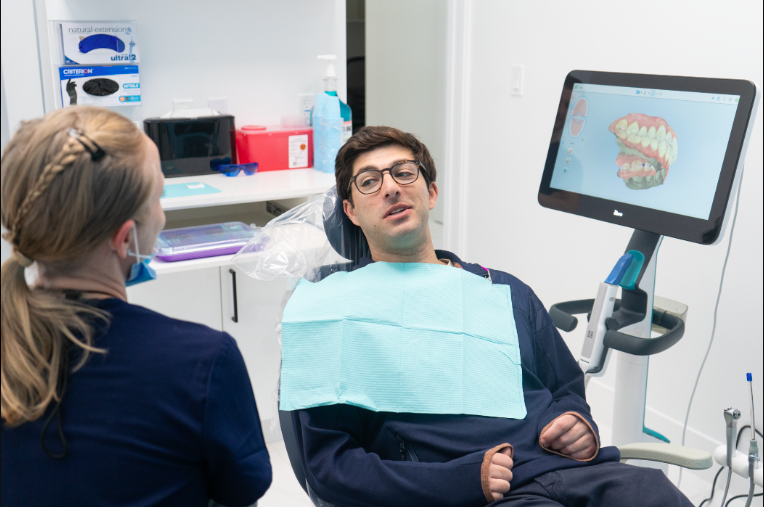
Dental Crowns & Bridges: Restoring Your Smile With Comprehensive Care Under One Roof
Whether the right solution is preserving your natural tooth with a crown, replacing a missing tooth with a bridge, removing a tooth that can't be saved, or planning an implant and final restoration, we'll walk you through your options and explain why we're recommending them.
Popular posts

A damaged or missing tooth can seem like a straightforward problem until you start hearing words like crown, bridge, extraction, implant, bone graft, or oral surgery.
Which one do you actually need?
At Honest Practices Dental, we believe the answer should start with understanding the entire situation, not simply choosing a procedure. Because sometimes a tooth can be restored with a crown. Sometimes it can’t. And when a tooth needs to be removed or replaced, the restorative and surgical sides of dentistry often need to work together.
That’s one of the advantages of having comprehensive general dentistry and oral surgery available in the same practice.
What Is a Dental Crown?
A dental crown is a custom-made restoration that covers and protects the remaining structure of a tooth.
Think of it as a new exterior for a tooth that has been weakened or significantly damaged. Rather than replacing the tooth itself, a crown is designed to preserve and restore the natural tooth underneath it.
A crown may be recommended when a tooth is:
- Cracked, broken, or significantly worn
- Weakened by a large filling
- Severely decayed
- In need of protection following certain dental treatments
- Being restored for functional or cosmetic reasons
Crowns can also be used as the visible portion of a dental implant when a natural tooth has already been lost.
The goal isn't simply to make the tooth look better. A properly planned crown should restore strength, function, bite, and appearance.
You can learn more about our dental crowns and bridges in Delray Beach, including when we may recommend a crown versus a filling or implant.
What Is a Dental Bridge?
A dental bridge is used to replace one or more missing teeth.
As the name suggests, it “bridges” the space created by a missing tooth. A traditional bridge typically uses the teeth on either side of the space for support, with an artificial tooth positioned between them.
Bridges are fixed restorations, meaning they aren't removed and replaced by the patient like a removable partial denture.
Depending on your individual situation, a bridge can be an effective way to restore your ability to chew, improve the appearance of your smile, and fill the space left by a missing tooth.
But a traditional bridge isn't the only option.
Dental implants can also replace missing teeth, either individually or as support for certain types of bridges. Determining which approach makes the most sense depends on the health of the surrounding teeth, gums and bone, as well as your overall treatment goals.
Crown, Bridge or Implant: How Do You Know Which One You Need?
This is where comprehensive treatment planning becomes especially important.
Imagine you have one badly damaged tooth.
If enough healthy tooth structure remains and the tooth has a good long-term prognosis, we may be able to preserve it and restore it with a crown.
But what if the tooth is fractured below the gumline, has extensive decay, or otherwise can't predictably be saved?
Now the conversation changes.
The tooth may need to be extracted, and you'll need to decide how — or whether — you'd like to replace it.
Depending on your individual case, options could include:
A traditional bridge: The missing tooth is replaced using the neighboring teeth for support.
A dental implant and crown: The damaged tooth is removed, an implant is surgically placed in the jaw when appropriate, and after healing, a custom crown is attached to the implant.
An implant-supported bridge: When multiple teeth are missing, implants may sometimes be used to support a bridge rather than relying exclusively on natural teeth.
There isn't one universally “best” solution. The right treatment depends on your teeth, bone, bite, health, goals, timeline, and other individual factors.
Where Oral Surgery Comes Into the Picture
Crowns and bridges are considered restorative dentistry, so patients don't always associate them with oral surgery.
But the two can overlap more than you might expect.
For example, let's say you come to Honest Practices Dental expecting to need a crown on a painful or badly broken tooth. After evaluating it, we determine that there simply isn't enough healthy tooth remaining to predictably restore it.
If a tooth extraction is necessary, our in-house oral surgery capabilities allow the restorative and surgical aspects of your care to be coordinated within the same practice.
That can be especially valuable when treatment involves:
- Tooth extraction
- Surgical extraction
- Dental implant placement
- Bone grafting when indicated
- Replacing an extracted tooth with an implant and crown
- Implant-supported restorations
- More complex treatment plans involving both damaged and missing teeth
Instead of treating the extraction as one isolated procedure and the eventual replacement as another, the entire treatment can be planned with the final result in mind.
Why Having Oral Surgery In-House Matters
When surgery and restorative dentistry are both involved, communication matters.
The person planning your final tooth replacement needs to understand what is happening surgically, and the surgical plan should take the intended restoration into consideration.
At Honest Practices Dental, having oral surgery in-house allows our general dentistry and oral surgery teams to collaborate on your treatment plan from the beginning.
For the patient, that can mean fewer outside referrals, less bouncing between unrelated offices, and a more connected experience from diagnosis through restoration.
More importantly, we're able to look beyond the immediate problem.
We're not only asking:
“How do we remove this tooth?”
We're also asking:
“What do we want the final result to be?”
That distinction can matter when planning an implant or other tooth replacement.
What If You Need an Extraction Before a Bridge?
Not every extracted tooth needs to be replaced with an implant.
In some situations, a traditional bridge may be an appropriate option. After the tooth is removed and the area has healed appropriately, the teeth surrounding the space can potentially be prepared to support a bridge.
In other cases, particularly when the neighboring teeth are healthy and don't otherwise need crowns, an implant may be considered because it can replace the missing tooth without requiring those adjacent teeth to support the restoration.
That's why we don't believe in automatically recommending the same solution to every patient.
We evaluate the entire picture first.
What If You Need an Implant?
Dental implants are different from traditional crowns and bridges because they replace the root portion of a missing tooth.
The implant itself is surgically placed into the jawbone. Once the area has healed and the implant is ready to support the final restoration, a crown can be attached to it to replace the visible portion of the missing tooth.
In certain cases, implants can also support a bridge when multiple teeth need to be replaced.
Because dental implant treatment has both a surgical component and a restorative component, coordination between the two phases is especially important.
Having both available through Honest Practices Dental means your care can be planned as one process rather than two disconnected procedures.
What Does the Crown or Bridge Process Look Like?
Every treatment plan is different, but crowns and bridges generally begin with a thorough evaluation.
We'll examine the affected tooth or missing-tooth area, review appropriate imaging, evaluate the surrounding teeth and tissues, and talk through your options.
If a natural tooth can be predictably restored, it may be prepared for a crown. Impressions or digital records are then used to create a restoration designed for your mouth, bite, and smile.
For a traditional bridge, the supporting teeth are prepared and the bridge is custom-made to restore the missing tooth or teeth between them.
If extraction, bone grafting, implant placement, or another surgical procedure is needed first, the timeline will be different. Healing is an important part of surgical treatment, and the final restoration is planned around that process.
We'll explain the steps, expected timeline, and alternatives before moving forward.
What If My Crown Breaks or My Tooth Suddenly Hurts?
Sometimes the crown or bridge conversation starts unexpectedly.
A crown may come loose, a tooth underneath a restoration may become painful, or an untreated tooth may fracture while you're eating. If you're dealing with sudden tooth pain, swelling, a broken tooth, or another urgent concern, our emergency dentistry team in Delray Beach can evaluate the problem and help determine what needs to happen next.
And needing an emergency visit doesn't automatically mean the tooth needs to come out. Whenever possible, our goal is still to determine whether the natural tooth can be predictably saved.
Can a Crown or Bridge Last Forever?
No dental work comes with a true lifetime guarantee — and we'd rather be honest about that.
Crowns and bridges are designed to be durable, but they're still exposed to years of chewing forces, bacteria, changes in your mouth, and everyday habits.
How long a restoration lasts can be influenced by factors including:
- Brushing and flossing
- Regular dental cleanings and exams
- Diet and frequency of sugar or acid exposure
- Grinding or clenching
- The health of the supporting tooth or teeth
- Gum health
- Your bite
- How the restoration is cared for over time
Our goal is to recommend treatment that makes sense for your individual situation and give you the information you need to protect that investment for as long as possible.
One Problem Doesn't Always Mean One Procedure
A broken or missing tooth isn't just a “crown case,” a “bridge case,” or an “oral surgery case.”
It's your mouth.
And the best treatment plan should consider what is happening today as well as what needs to happen next.
At Honest Practices Dental in West Delray Beach, our general dentistry and in-house oral surgery capabilities allow us to evaluate damaged and missing teeth from both the restorative and surgical perspectives.
Whether the right solution is preserving your natural tooth with a crown, replacing a missing tooth with a bridge, removing a tooth that can't be saved, or planning an implant and final restoration, we'll walk you through your options and explain why we're recommending them.
If you're dealing with a damaged or missing tooth — or you've been told you need a crown, bridge, extraction or implant and aren't sure which option makes the most sense — schedule an appointment with Honest Practices Dental for an evaluation.
No pressure. No surprises. Just honest dentistry.